
What Australia's 2026-27 Health Budget Signals for Health Service Organisations and System Integrators


Medora Advisor's Summary
Australia's 2026-27 Federal Budget put $598.3 million behind My Health Record and $25 billion into public hospitals, alongside meaningful commitments to aged care and mental health. The headlines focus on the dollars. We're more interested in the signal underneath. When budgets fund continuity, the digital layer often becomes where transformation quietly accelerates. Here's what we're watching, and why it's worth a closer look if you're a provider executive or a system integrator working in Australian health.
More Information: Reading the Budget as a Signal, Not Just a Spend
Most coverage has focused on the topline numbers, and rightly so. They're substantial. The AMA, the RACGP, and the RANZCP have each offered thoughtful commentary on where they'd like to see more, and that conversation will continue.
What we'd like to add is a different lens.
When a government invests significantly in continuity — keeping programs running, strengthening existing infrastructure, tightening integrity — it isn't standing still. It's making a quiet choice about where transformation will happen next. And often, that choice is the digital layer.
Look at the signals in this budget.
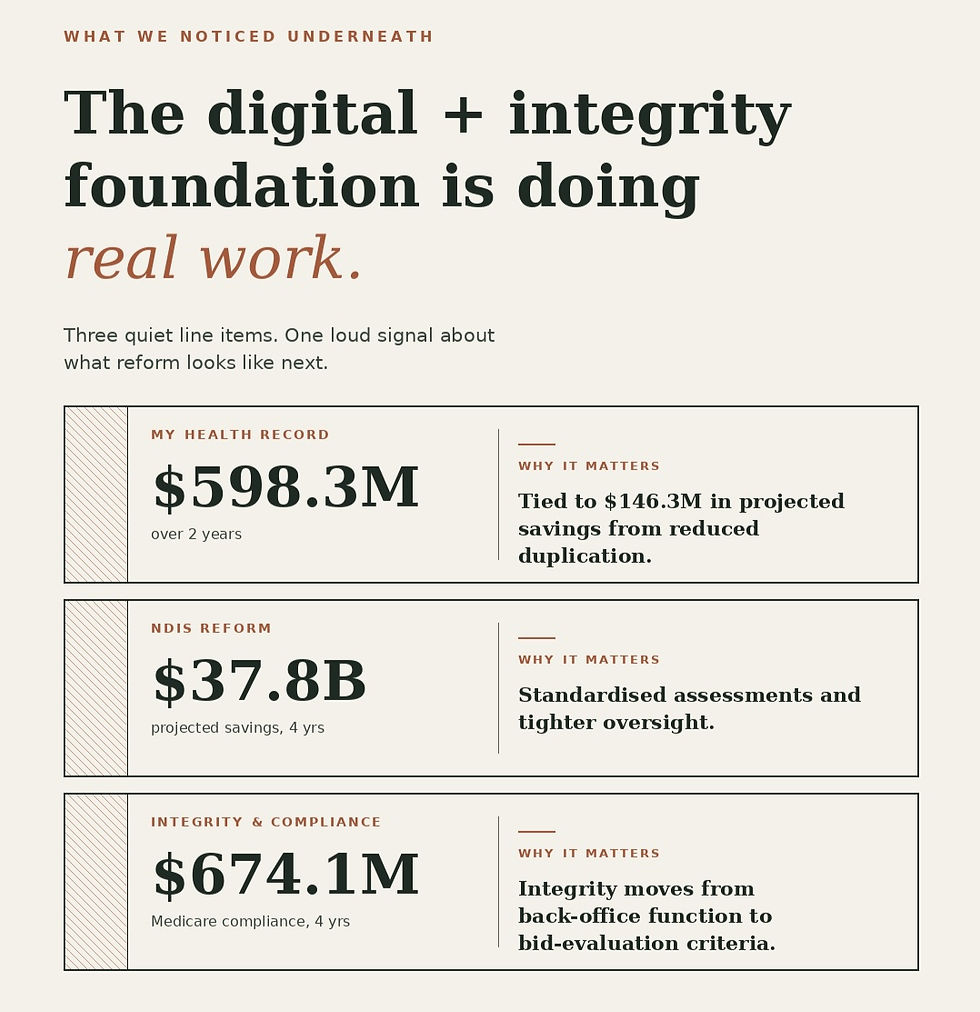
My Health Record received $598.3 million over two years, with a projected $146.3 million in savings from reduced duplicate imaging and pathology. NDIS reforms are projected to save $37.8 billion over four years through standardised assessments and better oversight. Medicare compliance and integrity work is expected to recover $674.1 million.
These aren't just line items. They're an investment thesis.
The thesis seems to be this: strengthen the digital and data foundation, and the system gains capacity to absorb future change. It's a measured, foundation-first approach. And it has real implications for the people who run, build, and support that foundation.
For Health Service Organisations(HSO) CIOs and clinical executives, the digital strategy you shape this year is doing a little more work than it did last year. My Health Record is now tied to publicly committed Commonwealth savings. The clinical workflows that touch it gain a kind of operational visibility they didn't quite have before.
For system integrators working in Australian health, end-customers — state health departments, Local Hospital Networks, aged care providers, NDIS service organisations — are increasingly looking for partners who can help them make the most of this foundation-first moment. That's a good thing. It rewards depth over breadth, and clinical-operational credibility over technical positioning alone.
The Department of Health and Aged Care and the Australian Digital Health Agency have both been consistent on this point over the last two years. Interoperability, data quality, and workflow integration are the foundations everything else builds on. The budget puts meaningful money behind that view.
What This Could Mean for HSO Operations
For Australian providers, this budget creates an opportunity to think a little more strategically about the digital foundation.
Clinical governance is one example. When My Health Record is tied to real Commonwealth savings, the workflows that depend on it become more visible. That's a good moment to bring clinical governance forward in the design process — treating it as a day-one consideration rather than something to confirm closer to go-live. It tends to make the downstream conversations easier.
Workflow protection is another. The temptation with any new funding cycle is to treat it as a technology refresh. The more useful framing is often workflow continuity. The funding enables modernisation, and the modernisation is most successful when the clinical and operational workflows it touches are protected and improved along the way.
Aged care and disability providers have something specific to consider too. The $3.7 billion in aged care investment and the $2 billion Thriving Kids program both depend on data flowing cleanly between providers, the Commonwealth, and families. The digital infrastructure makes that possible. The clinical and operational design makes it trustworthy. Both matter.
None of this is dramatic. It's just a gentle shift in where the centre of gravity sits.
What This Could Mean for System Integrators Bidding into Australian Health
For SIs, this budget reinforces a trend that's already been building.
Australian end-customers increasingly value bids that lead with clinical-operational understanding alongside technical architecture. State digital health strategies have been pointing this way for some time, and the budget gives that direction more momentum.
A few things worth keeping an eye on:
Vendor neutrality is reading as good risk management. End-customers appreciate partners who can engage governance conversations openly and bring options to the table rather than a single answer.
Workforce considerations matter more than ever. Any solution that changes how clinical work flows benefits from accounting for workforce impact early. The people who run the system want to be part of designing how it changes.
Integrity and compliance capability is increasingly front-of-house. With $674.1 million in projected Medicare compliance savings, this is becoming part of the value conversation, not just a back-office function.
The SIs doing well in this environment tend to be the ones who can move comfortably between clinical workflow, operational risk, and digital architecture in the same conversation. That's a real strength, and it's increasingly the thing end-customers are buying.
The Takeaway
This budget reads to us as a foundation-first moment. The investment in digital health, integrity, and continuity creates real opportunity for providers and SIs who are ready to build on it thoughtfully.
Honestly? The signal here is more interesting than the headlines suggest. There's a quiet bet on the digital and operational foundation that's worth paying attention to. Only you can really tell how it lands in your organisation, your portfolio, or your next bid. But it's a moment worth pausing on.
Conversation Starters
Could this budget shift how we frame our next EHR or digital health business case internally?
We're preparing a state health tender next quarter — does this change how we should position our clinical-operational story?
Our My Health Record integration has always been a compliance item. Should we be thinking about it as a workflow and savings lever now?
Let's Talk
If any of this resonates, or you're working through what the budget means for your operating model, bid strategy, or digital roadmap, we'd genuinely enjoy a conversation.


Comments